Choosing a care bed for looking after a relative at home
When a loved one is bedridden after a stroke or a fracture, the right bed protects both them and the carer's back. What matters: height adjustment, side rails, mattress and accessories.
reha.uz ·
Caring for someone in bed means dozens of lifts, turns and transfers a day. On an ordinary low bed the carer bends all the time and soon hurts their back, while the person cannot sit up or stand without help. A care bed solves both problems.
What it should have
- Electric height adjustment. Low, so the person can sit up and stand safely; high (about 80 cm), so washing, dressing and treatments do not mean bending over.
- Backrest and leg lift: the person sits up in bed, eats and talks with the family; raised legs reduce swelling.
- Side rails to prevent falls at night, ideally removable in seconds.
- A lifting pole with a handle, so the person can pull themselves up and keep strength in the arms.
- A lockable handset, so no button is pressed by accident.
The mattress
For someone who spends most of the day in bed an ordinary mattress is not enough. They need a pressure-relief mattress (orthopaedic foam or alternating pressure, depending on the risk). We choose it to fit the bed and the person's weight.
If there is a risk of falls
With dementia or restlessness a low bed is safer (Dali low-entry goes down to 23 cm), plus rail extensions, soft padding and an out-of-bed sensor.
How it looks
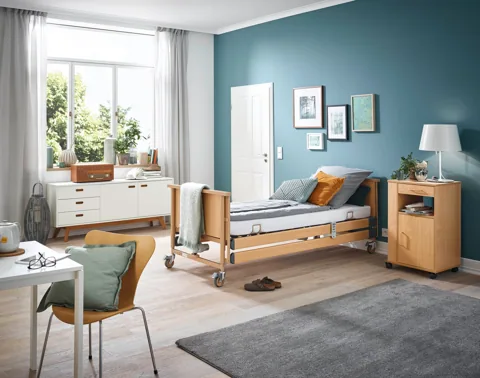
The bed stands in the room for months. Dali (Burmeier, Germany) looks like wooden furniture, not a hospital bed, which matters for the whole family's mood.
Call or message us on Telegram: tell us about the person's condition, weight and the size of the room, and we will suggest a bed, mattress and accessories with delivery.
This guide helps you prepare for a conversation with a doctor or therapist; it does not replace their advice.